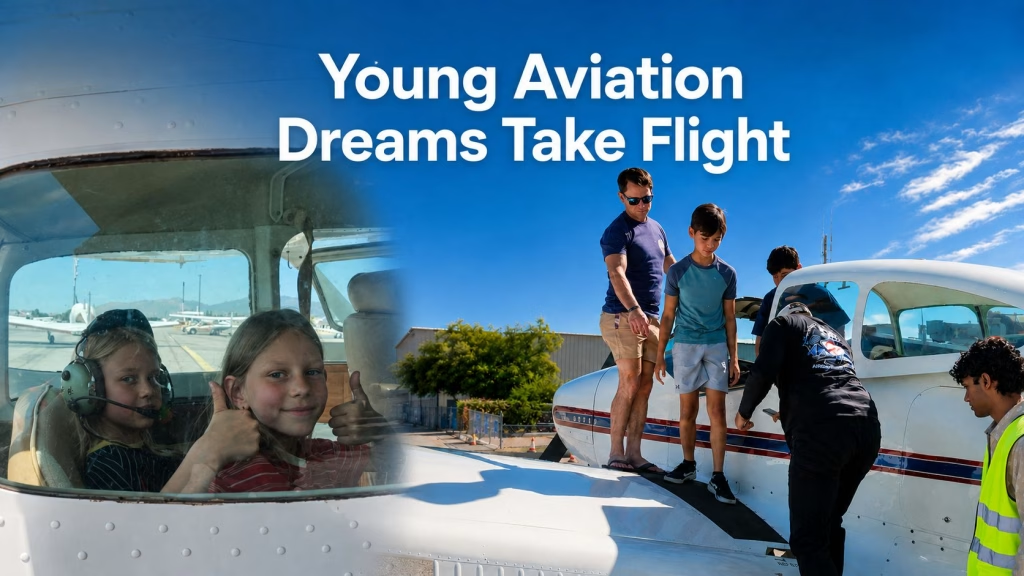
Eight-year-old Jason has loved airplanes for nearly as long as he can remember. He says he started liking them when he was only one or two years old.
Recently, at Whiteman Airport in Pacoima, he went from watching airplanes to flying in one.
Through the Experimental Aircraft Association’s Young Eagles program, Jason climbed aboard a Cessna 182 for his first ride in a general aviation aircraft. Sitting in the co-pilot’s seat, he watched arriving airplanes while they waited for takeoff and even had a chance to take the controls.

Jason later wrote to his pilot, Captain Dale King, to thank him and the other pilots who made the experience possible.
“You also let me drive a half of the whole flight,” he wrote. “I am very happy.”
It is hard to imagine a better review from an eight-year-old.
For Jason, the flight fulfilled a dream that began almost as soon as he could talk. For the pilots and volunteers at Whiteman, it was also part of something larger: introducing young people across Southern California to flying and to aviation careers they may never have imagined were within reach.
More Than a Ride in an Airplane
Young Eagles was created in 1992 to give young people ages 8 through 17 a free introduction to flight. EAA pilots such as Estevan Roth volunteer their time and aircraft and cover the expenses themselves.

More than 2.5 million young people around the world have participated. At Whiteman, EAA Chapter 40 has flown more than 13,478 Young Eagles and says it introduces an average of 75 to 100 young people to aviation each month.
The experience begins before the airplane leaves the ground. Participants learn how pilots prepare an aircraft, take part in a preflight demonstration and hear about educational opportunities and aviation careers.

For some young people, that first flight is only the beginning.
Building an Airplane and Learning Its History
Inside one of the airport’s hangars, students in EAA Chapter 40’s Youth Build Program work alongside experienced volunteers on a version of Loving’s Love, the distinctive racing airplane created by pioneering pilot and aeronautical engineer Neal V. Loving.
The project combines the technical challenge of building an aircraft with the remarkable story of the man who designed it.

Loving became the first Black pilot and the first double amputee licensed as a racing pilot. After losing both legs in a 1944 glider crash, he returned to the cockpit and continued designing and building aircraft. He later earned a degree in aeronautical engineering and went on to a distinguished career in aerospace research.
His best-known creation was the WR-1, a single-seat racing airplane with a distinctive inverted gull wing. Completed in 1950, Loving’s Love later carried its designer approximately 2,200 miles from Detroit to Kingston, Jamaica, including more than 200 miles over open water.
Instagram post
“Neal Loving faced barriers throughout his life, but he kept building, kept flying and refused to give up,” said Clyde Carpenter, president of EAA Chapter 40. “We want students to see that their dreams are possible and that real or perceived barriers do not have to define what they can achieve. That is the lesson we hope they carry with them.”
A Pathway for Young People
The Young Eagles and Youth Build programs are part of a wider network of youth aviation opportunities at Whiteman.
Aviation Explorer Post 747 introduces students to pilots, mechanics, air traffic controllers, airport professionals and aircraft design engineers. Members participate in ground school and may qualify for scholarship assistance toward flight lessons.
Kitty Hawk Squadron, Aviation Explorer Post 3, also offers ground school and flight training. Its history dates to 1953, when the program was founded by a teacher at San Fernando High School.
Civil Air Patrol Cadet Squadron 137 combines aerospace and STEM education with leadership development, mentoring, orientation flights and career exploration.
The San Fernando Valley Ninety-Nines provides mentoring, STEM activities, Girl Scout aviation programs and connections to scholarships for women pursuing aviation goals.
Together, these organizations create a pathway from a first flight to aircraft construction, ground school, flight training and career preparation, all at one community airport.
One Flight Can Open a Door
Jason’s mother, Sha, said her son came away with much more than a ride in an airplane.
“Jason has received so much from the EAA community, including Captain King’s flight, the warm welcome at Whiteman and a letter he will treasure for years,” she said. “We’ve told him that when you receive something special, you look for ways to give back. If his story encourages another kid to take that first flight, he’d be very proud to be part of that.”
That is why Jason and his family decided to share his story. They hope it encourages other children who looks up when an airplane passes overhead to take the first step toward discovering their own love of flying.
Learn More
Young Eagles flights at Whiteman Airport are available to young people ages 8 through 17. Advance registration is required.
For information about upcoming flights, the Youth Build Program and EAA Chapter 40, visit EAAChapter40.com.
Additional youth aviation opportunities are available through: